35 Year Anniversary Interview - Frederique and Cyril
When you think back to the early days, how did the Dutch Chamber first come into existence?
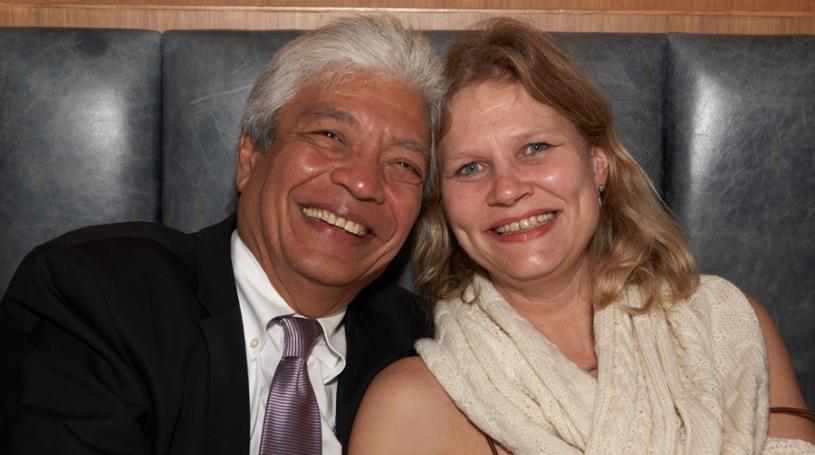
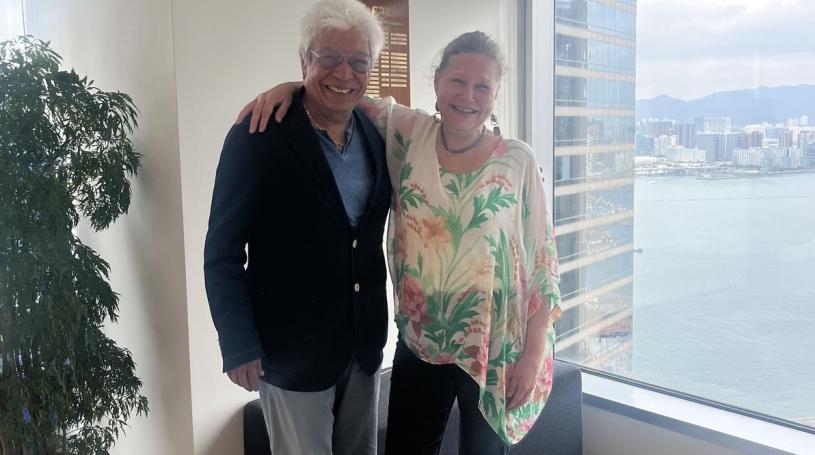
We have lived in Hong Kong for many years, and our connection to the Dutch community here goes back a long time. Cyril worked as a journalist for many years with the South China Morning Post, Radio Hong Kong and HK Standard. Because of his background in media and communications, he later became involved with the Dutch Business Association.
But the origins of the Chamber actually go back even earlier. During the 1980s, there was already an informal Dutch businessmen’s lunch group in Hong Kong. Senior representatives from the Dutch banks, Friesland Foods, and other major companies would meet socially and professionally. Those lunches created the relationships and momentum from which the Chamber eventually emerged. The organisation was formally established in 1991 as the Dutch Business Association (DBA), the predecessor of today’s Dutch Chamber of Commerce in Hong Kong. Around 50 founding members joined at the start.
Three Companies in particular played a leading role in bringing the organisation to life: Rabobank, ABN AMRO, and ING. They were the driving force behind the idea of creating a Dutch business network in Hong Kong. They formally registered the organisation and laid the foundation for what would later become DutchCham
Soon after the association was formed, the decision was made to create a small newsletter. It was very modest in the beginning — around three pages only. That would have started around 1992. Cyril got involved in 1993, when they wanted to upgrade their communications and publications. They were looking for someone with journalistic or media experience, so he joined on a voluntary basis. From there, the small newsletter gradually evolved into a proper monthly magazine. At that time, the major supporters of the DBA were what we referred to as the “big four”:
- ABN AMRO
- ING
- Rabobank
- Philips
They were key advertisers, and their support was important because advertising revenue covered the costs of production, printing, and distribution.
About a year later, the PR & Publications Committee decided to launch a Business Directory. That was the moment when more meaningful revenue started coming into the organisation. The magazine generated enough income to cover itself, but the directory became the stronger commercial product. It also introduced premium placements and “Gold Members.”
Frederiques’ involvement began through Bart Kimman, as she was working with him at the time. He and many of the same business leaders from those Dutch lunches were closely connected to the early association. Bart’s company, Brumby International Ltd., had a separate arm that handled incorporations and related services, which meant we became involved in helping establish the association formally as a non-profit. In those days, Frederique was effectively doing a bit of everything — helping Dutch people with whatever they needed in Hong Kong. She had just graduated from university, so she learned quickly by doing.
The Chamber remained relatively informal in the beginning, with monthly lunches and a small but active network. But soon afterwards, a proper board structure and several committees were created. This was likely around 1992 or 1993.
Those committees included:
- PR & Publications
- China Committee
- Business Activities Committee
- Membership Committee
- Treasury
The China Committee was particularly important at the time, because China was still much more of a mystery to many businesses than it is today. The annual China seminar (started in 1993) also became one of the Chamber’s key activities and revenue sources.
Frederique first joined the Business Activities Committee, where she served for many years. Later, she became Treasurer and held that role for quite some time.
Eventually, around 2005 or 2006, she was asked to step in as Chairwoman. These positions were entirely voluntary, and they required a serious time commitment if you wanted to do them properly. It was never a role people competed for — it was about giving back to the community.
During her chairmanship, one of the major milestones was the rebranding of the Dutch Business Association into the Dutch Chamber of Commerce in Hong Kong — the organisation we know today.
How did the establishment of the Dutch Chamber of Commerce happen?
Frederique:
When I was Chairman around 2005-2006, the Chamber had already matured significantly. We had a proper board structure, stronger finances, better continuity, and a solid reputation in the market. We had grown from an informal network into a recognised business platform within Hong Kong’s international community.
In practical terms, not much changed, as we were already operating as a not-for-profit organisation. But strategically, the new name better reflected who we had become. Many other international business communities in Hong Kong had already evolved into chambers, and it was the natural next step for us as well.
I am pleased to see that the logo and branding introduced at the time are still in use today. Before that, the image was much more traditional — tulips, windmills, and the Dutch national colours. The new identity gave the Chamber a more modern and professional look. Beyond the rebrand, much of the work focused on strengthening the organisation internally: improving back-office processes, tidying administration, and creating more structure. Those tasks may not be glamorous, but they are essential.
At the same time, the committees remained the real driving force behind the Chamber. Their energy and leadership created much of the activity and momentum. For a chamber representing a relatively small country, we were always considered one of the more active in Hong Kong. We could not compete in size with AmCham or the British Chamber, but among the European chambers, we were highly visible and very active.
We were also fortunate to receive strong support from the Dutch Consulate, which has always been important.
One ongoing discussion was how to balance business credibility with community spirit. We never wanted to become purely social, but we also knew that networking events with a social element often attracted the strongest attendance. That balance between business and community was always one of the Chamber’s greatest strengths.
Have you met any interesting people?
Absolutely. One of the great privileges of being involved with the Chamber was the opportunity to meet many notable Dutch visitors to Hong Kong.
At the time, the Dutch Consul General was Jochum Haakma. He was a larger-than-life figure — highly charismatic, energetic, and excellent in interviews. Whenever ministers or important visitors from the Netherlands came to Hong Kong, we would often arrange interviews with them for the Chamber magazine.
Through those connections, we met numerous prominent Dutch figures, including ministers, business leaders, and even members of the Royal Family. We met the Queen, and also had lunch with the current King, Willem-Alexander, when he was still Crown Prince.
One particularly memorable visit was by Annemarie Jorritsma. After arriving in Hong Kong, she remarked that she immediately felt at home because the foundations of Chek Lap Kok Airport had been built by a Dutch company. It was a wonderful quote and perfectly captured the Dutch contribution to Hong Kong’s infrastructure. We also met well-known Dutch personalities from sport, entertainment, and culture. Among them was a gold medal-winning swimmer, as well as a famous Dutch television chef who visited Hong Kong regularly for promotional events and cooking demonstrations. He was a colourful personality and certainly left an impression. There were also visits from artists, performers, and even members of the extended Royal Family, often connected to trade or cultural programmes organised with the Consulate.
Those encounters were one of the most enjoyable parts of being involved with the Chamber. They gave the Dutch community in Hong Kong a direct connection to important figures from home, while also showcasing Dutch talent and business internationally.
What were the most memorable events?
The big anniversary celebrations every five years — the Lustrum events. Those were special. People dressed formally, there were elegant venues, dinners, entertainment, and raffles. They felt like true milestone occasions. People genuinely looked forward to them. There were also many wonderful Consulate events. We interviewed Dutch ministers, business leaders, and public figures. We met Jeroen Krabbé, and even Laura Fygi when she performed in Hong Kong. Those were memorable days.
What has remained constant about the Dutch community in Hong Kong?
One constant has always been that, for a relatively small country, the Dutch presence in Hong Kong has been far greater than many people realise. The relationship between the Netherlands and Hong Kong has long been built on trade, logistics, entrepreneurship, and practical innovation, and that influence has been visible in many areas of the city’s development.
Over the years, Dutch companies were involved in major infrastructure and engineering projects, including land reclamation, transport systems, and airport-related works. Even practical features such as baggage carousel systems at Hong Kong International Airport were often associated with Dutch expertise.
There was also frequent discussion about the Dutch role in transport innovation. The concept behind Hong Kong’s highly efficient Octopus Card was often cited as having Dutch inspiration before being successfully adapted and implemented locally. Later, comparable smart-card systems were introduced in the Netherlands.
Even Hong Kong’s well-known purple HK$10 note was remembered by many as carrying Dutch design influence, particularly through its durable polymer-style material and modern visual style.
At the same time, the Dutch community itself has always consisted of two groups:
- professionals who come to Hong Kong for two or three years on international assignments
- long-term residents who quietly build lives, careers, and families here over decades
Thus, that traditional combination carries on to this day.